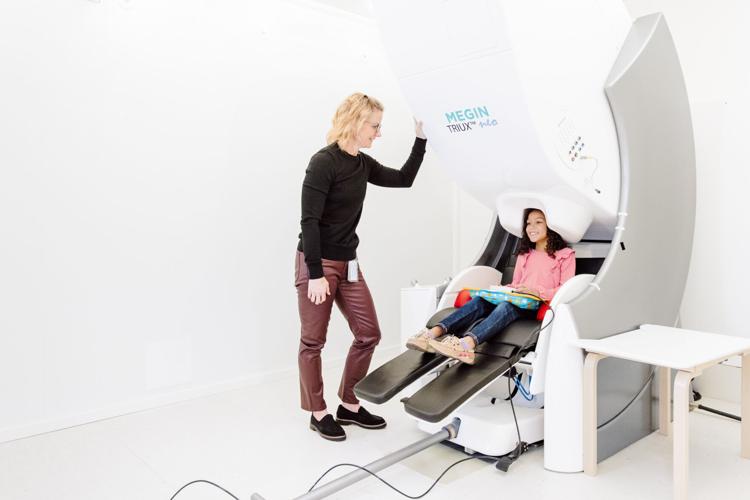


A participant undergoing a magnetoencephalographic (MEG) scan that measures and records her brain activity while playing brain games on a keypad. The Institute for Human Neuroscience is a leader in MEG imaging and houses the world’s most advanced MEG systems.
The Institute for Human Neuroscience (IHN) at Boys Town National Research Hospital in Omaha, Nebraska, is seeking individuals ages 11 to 18 with cerebral palsy to participate in a study.
How participants benefit
Participants will be financially compensated up to $300 for their time.
Participation in this valuable research will help scientists understand how the brains of youth with cerebral palsy control their movement and will kickstart the development of new physical therapy models.
Mobility is your right
“Mobility empowers an individual’s right to be an active participant in our society,” said Max Kurz, Ph.D., senior scientist and director of the Physiology of Walking and Engineering Rehabilitation (PoWER) Laboratory at IHN. He and his team have one primary goal for their research: to improve the approach to physical therapy treatments and healthcare for youth with cerebral palsy.
“A lack of adequate healthcare services directed at optimizing the mobility of persons with cerebral palsy infringes on their civil rights and represents a primary social injustice in our society,” said Dr. Kurz. “The mission of Boys Town is to change the way America cares for children and families; and our research specifically works to change the way society cares for this underserved population.”

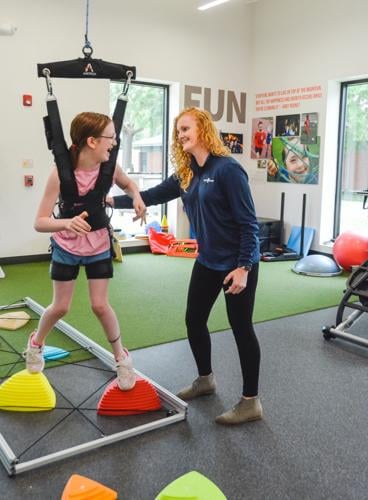
Katie Bemis, DPT, and a participant utilizing the Aretech® Zero G system in the Boys Town physical therapy clinic as the participant navigates an obstacle course.
Why mobility matters
Why is Boys Town National Research Hospital so passionate about supporting and understanding the mobility of youth with cerebral palsy?
Simply put, mobility — the power to move or be moved freely and easily — is how we experience life. Whether it’s through playing sports, exploring a nature trail, shopping, navigating school hallways or walking across the stage at graduation, movement is a part of our everyday lives and is primarily how people learn.
“From the time babies are developing in the womb, movement is influencing brain development,” said Katie Bemis, DPT, a physical therapist at Boys Town. “Babies who have started kicking in utero begin to develop motor patterns that will turn into walking and running. Sucking develops into feeding, eating and language. All of these are movement related.”

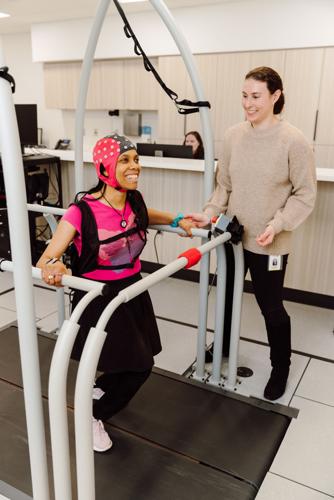
A research participant undergoing an EEG scan that measures her brain activity related to movement as she walks on a treadmill in the PoWER Lab at IHN.
About the study
Individuals with cerebral palsy who are interested in participating in this study must be between ages 11 and 18, have their parent’s or guardian’s consent and be able to complete three separate visits at IHN on Boys Town’s main campus.
During these visits, participants will perform walking assessments and moving tasks while imaging equipment such as MRI, EEG and MEG machines take pictures of their brain.
Participants will be financially compensated for each visit. Transportation and reimbursement for overnight accommodation will be provided for those who qualify.
How to join the study
To learn more about the study, call the PoWER Lab at 402.249.9465, email power@boystown.org or visit humanpowerlab.org to fill out an eligibility form, and someone from our team will be in contact with you.
About the Institute for Human Neuroscience
IHN is revolutionizing child and adolescent brain research.
Dr. Kurz and his team seek to better understand the walking abilities of youth with cerebral palsy by viewing an individual’s unique brain activity through safe, state-of-the-art machines that take pictures of the brain while the individual is moving.