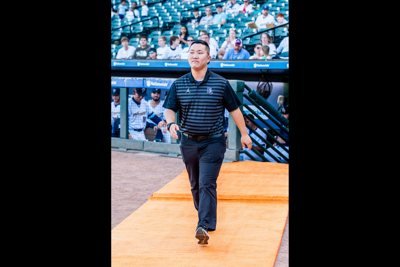


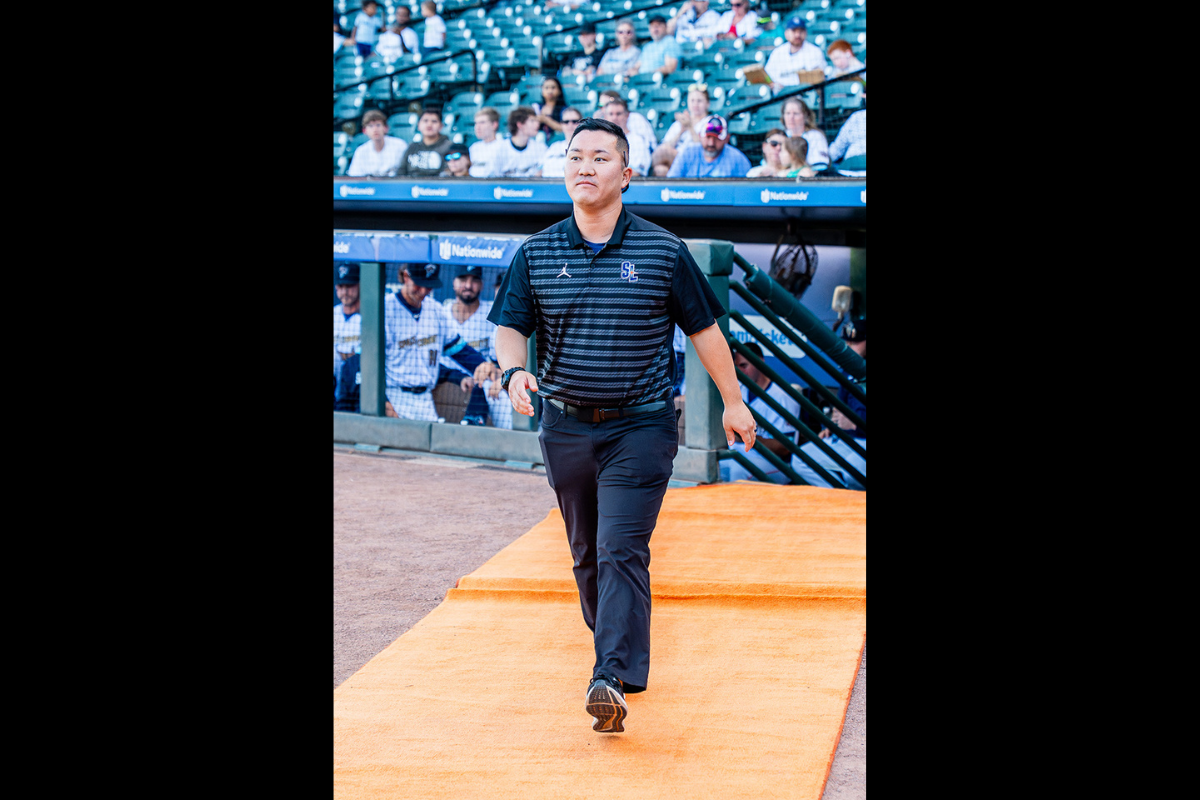
Okay, fine, he might not be in outer space, and he might not be on horseback wearing a cowboy hat, but University of Nebraska at Omaha (UNO) alumnus Takeaki Ando is still a space cowboy. A Sugar Land Space Cowboy, that is.
The Minor League Baseball team based outside of Houston, Texas, is the Triple-A affiliate team of the Houston Astros. (For the non-baseball readers, that’s the team one step below the Astros, where many players gain reps and experience before getting called up to the big leagues.)
It’s there where, day in and day out, Takeaki Ando ensures that the professional ballplayers are in tip-top shape as the organization’s head athletic trainer.
His journey to the American sports world began in his hometown of Tokyo, Japan.
“I used to play baseball,” Ando says of his childhood. “I found that I love sports.”
People are also reading…
That love of sports never faded, so when Ando entered college at Waseda University in Saitama, Japan, he began his studies in sports science.
During his undergraduate program, Ando and his peers took a trip to Stanford University as part of the two schools’ long-standing academic and cultural collaborations.
“[We] went to Stanford University for summer camp, football summer camp, and we spent two months almost,” Ando recalls about the 2013 camp. “That was my first exposure to athletic training and also the football experience in the U.S.”
That’s when it all clicked for Ando; he knew athletic training in the United States would be his path.
About a year later, he made another trip to the United States to visit potential schools for his graduate degree in athletic training. UNO made his list of campuses to visit.
While here, he met the athletic training program’s director at the time, Melanie McGrath, along with another Japanese student.
Ando almost immediately made up his mind.
“I felt more comfortable,” he said, after discussing the program and the grad school process as a whole. “So that's why I chose to go to UNO.”
The only issue? Ando didn’t speak much English. Although he began studying English while taking his undergraduate courses, his language skills weren’t ready for an all-English graduate school program.
So, Ando participated in UNO’s Intensive English Program, a several-month-long English as a Second Language program designed to help international students. After that, he was diving headfirst into the UNO athletic training program.
He knew he was on the right path.
“Sports medicine is always changing, so they [were] actually staying on top of those to teach us recent evidence-based stuff,” he says of the program.
Now, about 10 years removed from the program, Ando thinks back on his time at UNO with fondness and a feeling of genuine support. He describes it as a “warm family feeling.” It’s the same feeling he says he got when he first visited the campus.
“First of all, the people at UNO [are] very welcoming, from my perspective, to international students. They’re willing to help us out,” he said.
Ando says the university’s support of international students made a huge difference in his experience.
“That’s the biggest benefit. If you are considering which school you want to go to, there’s actually a built-up program there at UNO.”
UNO was the launchpad for Ando’s career and success in professional athletics. But it wasn’t immediate; it took years of experience to get where he is now. That experience began during his time at UNO, when he was assigned a clinical rotation at Creighton University, getting his first hands-on experience with a range of student-athletes.
After graduating with his master’s degree, Ando then interned at the University of Louisville, working with the track & field and cross-country teams. After that, he went back to school for his second master’s degree at New Mexico State. There, he was a graduate assistant with the baseball team.
“That’s where I experienced working by myself, by working with the baseball team for a year and a half,” he says.
Then, Ando made the jump from college to the professional level, getting his first job for a minor league baseball team in Florida.
“Don't get me wrong, the college players [are] also taking baseball serious, but for the professional baseball players, I mean, that's a job for them,” Ando says. “If they lose the job, then they don't have a job. That’s the biggest difference I felt. They’re taking care of their business.”
Athletic trainers, especially for high-level sports teams and athletes, require the same intense schedule as the athletes themselves.
After a month-long spring training (the preseason for all the non-baseball readers), the roughly five-month season of 150 games in the minor leagues means Ando is traveling to a new city every week with very few off days. On a daily basis, he and his training staff are in charge of around 30 athletes, helping each of them with injury prevention, injury assessment and treatment, and rehabilitation, all of it tailored to each player and their position on the playing field.
Every day, Ando’s expertise is being used to protect, develop, and guide athletes, helping them be their best. It’s exactly the life he once dreamed of for himself, too, and one he worked hard to achieve.
“That was my goal for sure. Once I moved here [to the United States], I wanted to work with a professional team, and wanted to see myself achieve that goal,” Ando adds.
This season marks Ando’s third consecutive as the Sugar Land Space Cowboys’ head athletic trainer.
“I’m still in the process, because I am still in the minor league system. My ultimate goal is, you know, going to the major league team.”
Although his journey has taken him many places, it was UNO that gave him the linguistic, educational, and cultural groundwork he needed to be ready for each step of his career.