





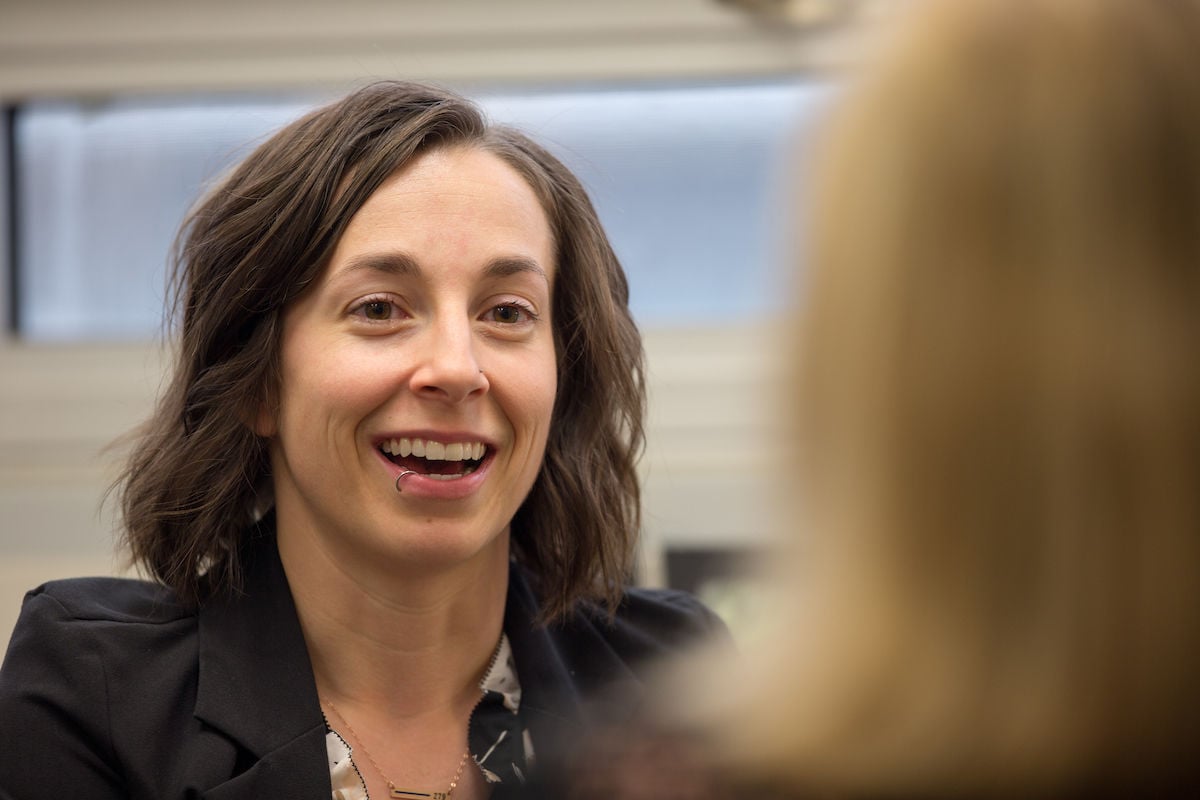
Lauren Ward arrived on the campus of Penn State in 1999, eager and wide-eyed as any 18-year-old beginning her journey into higher education and adulthood.
She had come to study criminal justice, to join an elite collegiate fencing team and, in that storied undergraduate tradition of discovery, to search out her place in the world.
For Ward, that search quickly took an irreversible detour. She was sexually assaulted in the first semester of her freshman year.
Since that time, she has shared her story publicly. She says she was attending an off-campus party, drank too much and passed out. She awoke and found herself being raped by another partygoer — a young man she hardly knew, but who would linger in her psyche for years to come.
Suddenly, she’d found herself with a new identity. She was a victim.
People are also reading…
That stigma, Ward would find, can be consuming.
“The victimization becomes the lens through which you see everything, at least for a period of time,” she says, from her office in Creighton University’s Violence Intervention and Prevention (VIP) Center. “And what’s so interesting is that anyone who you tell, it’s often the lens through which they see you.”
In the years that followed the assault, Ward would undertake a phenomenal personal journey, transforming from victim, to survivor, to a woman on a mission.
Today, she leads Creighton’s VIP Center, the aim of which is two-fold: to provide confidential advocacy to survivors of sexual violence, dating violence and stalking, and — crucially — to prevent these incidents through proactive education and awareness programs.
In its approach to victim advocacy, the VIP Center — established on campus in 2011 and steered by Ward since 2014 — takes its critical cue from the Ignatian mantra of cura personalis, or care for the individual person.
“We take the concept literally, providing individualized support to each student, faculty and staff member who needs us,” she says. “Sometimes that simply means we are there to listen. Other times, it means we take action.
“Always,” she continues, “we meet survivors of violence and abuse ‘where they’re at’ — in other words, we are here to serve their objectives, and no one else’s.”
That tailored support can take the shape of helping a victim report an incident to authorities, on or off campus; assisting with applying for protection orders; helping to navigate through class absences, coursework extensions and housing matters; and, for secondhand survivors, resources and support on how to assist a friend, partner, roommate or family member.
As word has spread about the VIP Center, and Ward and her colleagues traverse campus giving prevention and awareness presentations — nearly 100 of them in the last reporting year, reaching more than 6,500 students, faculty and staff — the demand for the center’s services has increased markedly. Utilization of the center has quadrupled since 2011.
Is that statistic a cause for concern? Yes, Ward says. But, she explains, it doesn’t mean that Creighton has a unique problem with these issues.
“Absolutely it’s a problem here. It’s a problem on every college campus and in every community nationwide,” she says. “Anywhere, especially any college campus, where they tell you it’s not a problem, run screaming, because they are hiding something.”
What does make Creighton unique, at least among other Nebraska colleges and universities, is that it’s the only one with a full-time, campus-based advocate for victims of sexual violence. And Creighton employs two such advocates.
It’s testament, Ward says, to the university’s commitment to addressing its slice of a national epidemic — an investment in protecting the members of its community; one that isn’t beholden to vanishing funds tied to grants.
“We’re not subject to a lot of ebb and flow with grant funding, because Creighton has committed almost entirely the funds and the space and all of the resources it takes for what we do here,” she says.
Read more of Ward’s story in Creighton University Magazine.
Creighton University offers a top-ranked education in the Jesuit, Catholic tradition. Read more about the university, and connect with Creighton on Facebook, Twitter and Instagram.